Explaining Auto and Bus Fare to Kids: 5 Brilliant Ways to Teach Transport Costs
Explaining auto and bus fare to kids is essential for building financial literacy and practical life skills in today’s urban world. In this comprehensive guide, you’ll discover effective strategies to help children understand transportation costs, make smart travel choices, and develop responsible money management habits from an early age.
“Transportation costs are often children’s first encounter with regular financial transactions in their daily lives.”
Explaining Auto and Bus Fare to Kids: Why It Matters
Explaining auto and bus fare to kids goes beyond simple arithmetic—it’s about teaching children the value of money, decision-making, and understanding the connection between choices and costs. In Indian cities where auto-rickshaws and buses are primary modes of transport, these lessons have immediate relevance to children’s daily experiences.
“Understanding transportation costs helps children see money as a tool for accessing services rather than just for buying things.”
Children encounter transportation costs regularly—whether traveling to school, visiting relatives, or going for family outings. Making these costs understandable and meaningful creates natural learning opportunities that build financial literacy foundations.
Why Explaining Auto and Bus Fare to Kids Creates Smart Financial Thinkers
Explaining auto and bus fare to kids provides immediate, practical applications of mathematical concepts and financial decision-making. Unlike abstract money lessons, transportation costs have visible consequences and alternatives that children can understand and evaluate.
“Real-world transportation decisions teach children that financial choices have immediate and tangible outcomes.”
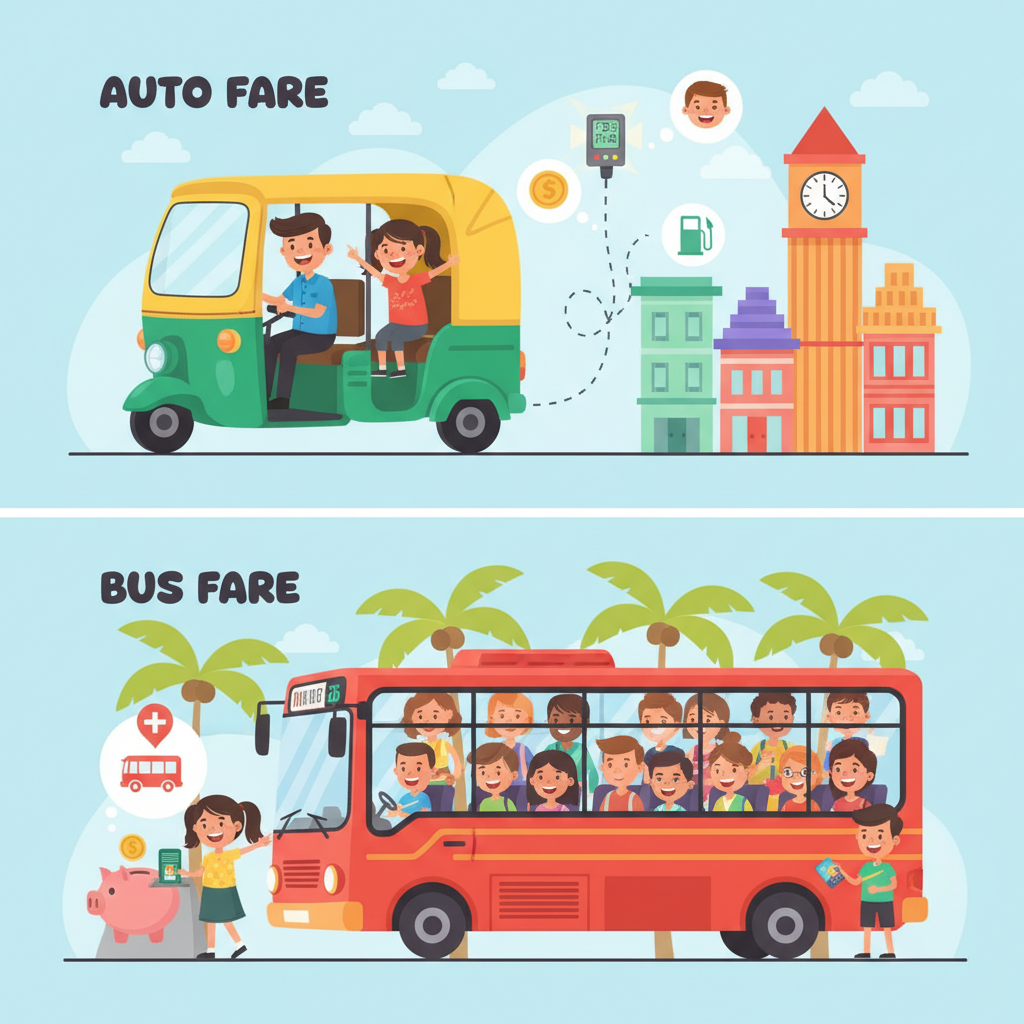
When children understand that taking an auto costs more than a bus but saves time, they begin to grasp complex concepts like trade-offs, value assessment, and opportunity cost. These early experiences with transportation cost analysis build cognitive frameworks that support more sophisticated financial reasoning later in life.
The regular nature of transportation expenses also helps children understand budgeting and planning. They learn that regular trips require regular money, introducing the concept of recurring expenses and financial planning.
When Explaining Auto and Bus Fare to Kids Can Create Confusion
Despite the benefits, explaining auto and bus fare to kids can sometimes lead to misunderstandings that hinder rather than help financial literacy. When concepts are introduced too abstractly or without proper context, children may develop incorrect assumptions about how transportation costs work.
“Overly complex explanations can make transportation costs seem mysterious rather than understandable.”
Another common mistake is focusing solely on cost without explaining the value and convenience factors. Children might conclude that the cheapest option is always best without understanding why someone might choose a more expensive auto for specific situations like emergencies, time constraints, or carrying heavy items.
Some children also struggle with understanding distance and time factors that influence transportation costs. Without proper context, they may wonder why the same route costs different amounts at different times or why longer distances cost more.
Explaining Auto and Bus Fare to Kids: Strategy 1 – Visual Fare Cards
Create simple visual cards that show different transportation options with their costs. Use pictures of autos, buses, and other transport modes with clear price tags that children can understand.
“Visual representations make abstract fare concepts concrete for young minds.”
For younger children, use actual coins or play money next to transport pictures to show the cost difference. For older children, create simple charts comparing different routes and their costs. This visual approach helps children see the relationship between distance, mode of transport, and cost.
Update these visual aids regularly with current fare information from local transport authorities. The Ministry of Road Transport and Highways provides information on transportation regulations that can help ensure your fare information is accurate.
Explaining Auto and Bus Fare to Kids: Strategy 2 – Real-World Practice Trips
Take children on practice trips where they help calculate and pay for transportation. Start with simple bus rides where children can help count the fare and hand over money to the conductor.
“Hands-on experience with real transactions creates deeper understanding than theoretical lessons alone.”
For auto rides, involve children in the process—show them the meter starting, explain how distance affects cost, and let them help pay when you reach the destination. These real experiences make fare concepts tangible and memorable.
Consider giving older children a small budget for specific trips and letting them decide how to use it—whether to take a more expensive auto or save money by taking the bus. This practical decision-making builds valuable financial judgment.
Explaining Auto and Bus Fare to Kids: Strategy 3 – Fare Comparison Games
Create games where children compare different transportation options for various scenarios. Present situations like “Grandma’s house is 5 km away—what’s the best way to get there?”
“Comparison games turn abstract fare analysis into engaging decision-making practice.”
Use real fare information and factors like time, convenience, and cost. Have children rank options based on different priorities—sometimes cheapest is best, other times fastest matters most. This teaches them that financial decisions depend on context and priorities.
Make these games relevant to your family’s actual destinations—school, relatives’ houses, favorite parks, or shopping areas. Using familiar locations makes the exercise more meaningful and applicable to children’s daily lives.
Explaining Auto and Bus Fare to Kids: Strategy 4 – Digital Fare Awareness
Introduce children to digital fare payment methods and apps. Many cities now have apps that show auto and bus fares, and understanding these digital tools is increasingly important for financial literacy.
“Digital fare awareness prepares children for modern transportation systems while building financial technology literacy.”
Show children how fare calculation apps work, how digital payments are made, and how to verify that the correct fare is being charged. The National Transport Card system information can help explain digital payment options for public transport.
For older children, discuss surge pricing during peak hours and how demand affects transportation costs. This introduces basic economic concepts of supply and demand in a context they can observe directly.
Explaining Auto and Bus Fare to Kids: Strategy 5 – Budget Planning for Regular Trips
Help children understand transportation costs as part of regular budgeting. Calculate monthly costs for regular trips like school commutes and discuss how these fit into family budgets.
“Understanding recurring transportation costs builds foundation for broader budget awareness.”
For children who take autos or buses to school, help them calculate weekly or monthly costs and compare this to other expenses like snacks or toys. This helps them understand transportation as a significant category of spending rather than isolated transactions.
Create simple savings challenges where children can “earn” a special auto trip by saving money on regular bus rides. This teaches delayed gratification and the relationship between daily choices and special rewards.

Explaining Auto and Bus Fare to Kids: Age-Appropriate Approaches
For Ages 4-7
Focus on basic recognition and simple concepts. Young children can learn to identify different transport modes, understand that they cost money, and recognize that some options cost more than others.
“Early exposure to transportation concepts builds familiarity for more complex understanding later.”
Use simple language, lots of visual aids, and concrete examples. Focus on immediate experiences rather than abstract concepts. Play games involving transport and money to build positive associations.
For Ages 8-12
Introduce more complex concepts like fare calculation, comparison shopping, and basic budgeting. School-age children can understand how distance affects cost, why peak hours cost more, and how to evaluate different transport options.
“Elementary-age children can handle surprisingly sophisticated transport cost analysis with proper guidance.”
Involve them in real decision-making about family transportation choices. Give them specific responsibilities like calculating fare for family outings or researching the best way to get to destinations.
For Teens
Challenge teenagers with advanced concepts like surge pricing analysis, digital payment security, and transportation budgeting for independence. Teens can understand how transportation costs fit into larger financial planning and independence.
“Teenage transport education prepares them for independent financial decision-making in adulthood.”
Consider giving teens responsibility for managing their own transportation budget for specific activities or part-time work commutes. This real-world responsibility builds practical financial skills.
Explaining Auto and Bus Fare to Kids: Safety Considerations
Personal Safety Alongside Financial Literacy
When teaching children about transportation costs, include important safety lessons. Understanding fare negotiation should never compromise personal safety.
“Financial education must always prioritize children’s safety and well-being.”
Teach children to use prepaid auto services when available, verify that meters are used correctly, and know how to contact authorities if they feel unsafe. The Ministry of Home Affairs provides safety guidelines for public transport that can supplement these lessons.
Digital Payment Safety
As children learn about digital fare payments, include lessons on digital safety. Teach them to protect personal information, verify payment amounts before confirming, and understand the risks of sharing payment information.
“Digital literacy must include both convenience and security awareness.”
Advantages of Teaching Transportation Cost Awareness
Real-World Application
Transportation cost knowledge has immediate practical application in children’s daily lives. Unlike abstract financial concepts, understanding auto and bus fares helps children make real decisions they encounter regularly.
“Practical financial knowledge creates confidence and competence in real-world situations.”
Mathematical Skill Development
Fare calculation involves mathematical concepts like addition, multiplication, percentages, and basic algebra. These skills develop naturally through real-world application rather than abstract exercises.
Decision-Making Practice
Evaluating transportation options requires children to consider multiple factors—cost, time, convenience, safety—and make balanced decisions. This decision-making practice extends beyond transportation to other life choices.
Challenges in Transportation Cost Education
Variable Pricing Complexity
Auto and bus fares often vary based on time, distance, demand, and other factors. This variability can be confusing for children who expect consistent pricing.
“Variable pricing requires children to develop flexible thinking about financial concepts.”
Regional Differences
Transportation systems and fare structures vary significantly across Indian cities and regions. What works in one city may not apply in another, requiring localized education approaches.
Rapid System Changes
Transportation systems, especially digital platforms, evolve quickly. Keeping educational content current can be challenging as new apps, payment methods, and fare structures emerge.
Frequently Asked Questions
1. At what age should I start teaching my child about auto and bus fares?
Start around age 4-5 with basic concepts like identifying different transport modes and understanding they cost money. Gradually introduce more complex concepts as children grow, with detailed fare calculation appropriate for ages 8 and above.
2. How do I explain why autos cost more than buses for the same route?
Explain that autos provide personal service, direct routes, and comfort, while buses carry many people and make multiple stops. Use analogies like how a private taxi costs more than shared transportation in other contexts.
3. Should I let my child pay for auto and bus rides themselves?
Yes, when age-appropriate. Letting children handle money for transactions builds confidence and practical skills. Start with small amounts and simple transactions, gradually increasing responsibility as they demonstrate competence.
4. How do I teach about digital fare apps and payment systems?
Start by showing them how you use the apps, explaining the basic functions. For older children, let them help plan routes and estimate fares using apps under your supervision. Always include safety lessons about digital payments.
5. What if my child is afraid to travel alone on buses or autos?
Address fears gradually. Start with short, supervised trips, then progress to independence as confidence builds. Focus on safety skills and knowledge rather than forcing independence before they’re ready.
6. How do I explain surge pricing during peak hours?
Use simple supply-andemand concepts. Explain that more people want rides at certain times, so prices go up, similar to how popular toys might cost more during holiday seasons. Use real examples they’ve observed.
7. Should I teach my child to negotiate auto fares?
Teach awareness of standard fares and when negotiation might be appropriate, but prioritize safety over saving money. Children should know when to insist on meter use and when to walk away from unreasonable demands.
8. How do I make transportation cost education engaging?
Turn lessons into games, use real-life examples, involve children in actual trip planning, and celebrate when they make smart transportation decisions. Connect learning to their interests and daily experiences.
9. What if the fare information I teach becomes outdated?
Acknowledge that transportation systems change and regularly update your knowledge. Use this as an opportunity to teach children about checking current information and adapting to changing systems.
10. How do I teach about transportation safety alongside cost awareness?
Integrate safety lessons into every transportation discussion. Teach children to verify meters, use reputable services, know emergency contacts, and trust their instincts about unsafe situations.
11. Can these strategies work in rural areas with different transport options?
Adapt the core principles to local transportation contexts. Whether it’s buses, autos, shared tempos, or other local transport, the concepts of cost comparison, value assessment, and safe travel remain relevant.
12. How do I measure if my child understands transportation costs?
Look for application in real situations—when they start comparing options, understanding fare calculations, or making thoughtful transportation choices independently. Remember this is a gradual learning process.
Conclusion
Explaining auto and bus fare to kids is an essential component of comprehensive financial literacy that prepares children for independent life in urban environments. By implementing the five strategies outlined in this guide—visual fare cards, real-world practice trips, fare comparison games, digital fare awareness, and budget planning for regular trips—you can help children develop practical financial skills that extend beyond transportation to general money management.
The key is making transportation cost education relevant, engaging, and age-appropriate. Start with basic concepts and gradually increase complexity as children grow. Remember that the goal is not just teaching about fares, but building the decision-making skills and financial awareness that will serve children throughout their lives.
For more resources on financial education for children or personalized guidance for your family’s needs, visit our services page or contact our team. You can also explore our blog for additional articles on practical financial literacy strategies for families.
This content is for educational purposes and does not constitute personalised financial advice. For personalised advice, visit our services or contact pages.