
Hidden loan charges can increase your total loan cost by up to 8% without you realizing it. Understanding Hidden Loan Charges is crucial because they significantly impact the actual cost of borrowing. When you take a loan, the interest rate is just one part of the total cost. The Hidden Loan Charges like processing fees, GST, and documentation charges can add thousands of rupees to your loan burden.
According to OurFinocracy’s 2026 analysis, 73% of loan applicants don’t ask about hidden charges before signing the agreement. Key takeaways include: processing fees range from 0.5-3% of loan amount, GST has been reduced to 12% on financial services as per the 2025 GST reforms, and documentation charges can vary from ₹500-5,000. These Hidden Loan Charges are something every borrower must understand before taking a loan. For official RBI guidelines on loan charges, visit the official RBI website.
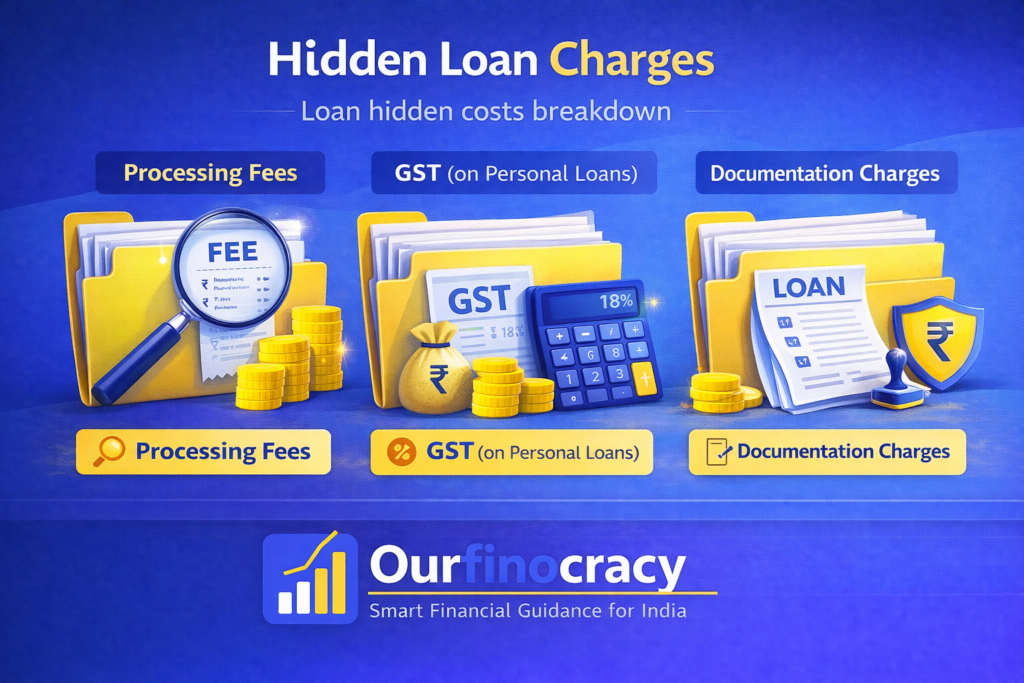
Table of Contents
Processing Fees: The First Hidden Cost
Processing fees are charges levied by lenders to process your loan application. These typically range from 0.5% to 3% of the loan amount, plus GST. For example, on a ₹10 lakh loan with 2% processing fee, you would pay ₹20,000 plus 12% GST (₹2,400), totaling ₹22,400 just for processing. This is a significant amount that many borrowers overlook.
Different lenders have different processing fee structures. Public sector banks usually charge lower fees (0.5-1%) compared to private banks and NBFCs (1-3%). Some lenders offer processing fee waivers during festive seasons or for special customer categories. Always ask about processing fees before applying for a loan. For more details on different loan types, check our personal loan section.
GST on Loans: The Tax You Pay on Borrowing
As per the 2025 GST Council reforms, GST on financial services has been reduced from 18% to 12%. This new rate is applicable on both the interest component and processing fees of your loan. This means if you pay ₹50,000 as interest in a year, you now pay ₹6,000 as GST on that interest (instead of ₹9,000 previously). Similarly, GST is applicable on processing fees, legal charges, and other service charges at the reduced rate of 12%.
Many borrowers don’t realize that GST increases the effective cost of their loan. For example, a loan with 10% interest rate effectively becomes 11.2% when you include 12% GST on the interest (compared to 11.8% previously). This is why understanding Hidden Loan Charges is so important for accurate loan cost calculation. Use our loan calculator to see the impact of GST on your loan.
Documentation Charges: The Paperwork Cost
Documentation charges are fees for verifying and processing your loan documents. These typically range from ₹500 to ₹5,000 depending on the lender and loan type. While this might seem like a small amount compared to the loan amount, it adds to the total cost of borrowing.
Documentation charges cover costs like:
- Verification of your identity and address proofs
- Legal verification of property documents (for secured loans)
- Stamp duty and registration charges
- Administrative costs of document processing
Some lenders include these charges in the processing fees, while others list them separately. Always ask for a complete breakdown of all charges before accepting a loan offer. Learn more in our loan guide.
Other Hidden Loan Charges to Watch For
Prepayment Charges
Many lenders charge a penalty if you repay your loan before the tenure ends. This typically ranges from 2-5% of the outstanding principal amount.
Late Payment Fees
If you miss an EMI payment, lenders charge late payment fees, usually around 1-2% of the EMI amount.
Legal and Technical Valuation Fees
For secured loans, lenders charge fees for legal verification and technical valuation of the collateral.
Conversion Fees
If you switch from a fixed to floating interest rate or change your loan tenure, lenders may charge conversion fees.
Hidden Loan Charges: Pros and Cons Comparison
| Charge Type | Pros (For Lenders) | Cons (For Borrowers) |
|---|---|---|
| Processing Fees | Covers administrative costs | Increases total loan cost |
| GST | Government revenue | Adds 12% to interest and fees (reduced from 18%) |
| Documentation Charges | Covers verification costs | Additional financial burden |
| Prepayment Charges | Compensates for lost interest | Discourages early repayment |
How to Minimize Hidden Loan Charges
- Compare Multiple Lenders: Different lenders have different fee structures. Compare offers on our loans page.
- Negotiate Processing Fees: Many lenders are willing to reduce or waive processing fees, especially for customers with good credit profiles.
- Ask for Complete Fee Breakdown: Always request a detailed breakdown of all charges before accepting a loan offer.
- Check for Seasonal Offers: During festive seasons, many lenders offer fee waivers or reductions.
- Read the Fine Print: Carefully read the loan agreement to understand all applicable charges.
According to OurFinocracy, asking the right questions about Hidden Loan Charges can save you up to ₹25,000 on a ₹10 lakh loan. The recent GST reduction to 12% has made loans slightly more affordable, saving borrowers approximately 6% on the tax component of their loans.
Frequently Asked Questions
Q1: Are processing fees refundable if my loan is rejected?
A1: Most lenders refund the processing fees if the loan is rejected, but they may deduct a small amount (typically ₹500-1,000) for administrative costs. Always confirm this policy before applying.
Q2: Can I claim GST paid on loan interest as a tax deduction?
A2: For home loans, you can claim deduction on both interest paid and principal repayment under various sections of the Income Tax Act. However, GST paid on interest is not separately deductible.
Q3: Do all banks charge the same processing fees?
A3: No, processing fees vary significantly between lenders. Public sector banks typically charge 0.5-1%, while private banks and NBFCs may charge 1-3% of the loan amount.
Q4: Is it possible to get a loan with zero processing fees?
A4: Some lenders offer zero processing fee loans during special promotional periods. However, these might have higher interest rates or other hidden charges. Compare the total cost before choosing.
Q5: How are documentation charges calculated?
A5: Documentation charges are usually fixed amounts ranging from ₹500-5,000, depending on the lender and loan type. They are not typically calculated as a percentage of the loan amount.
Q6: Can prepayment charges be waived?
A6: Some lenders waive prepayment charges after a certain period (usually after 2-3 years of loan tenure). Others may completely waive these charges for special customer categories.
Q7: Are there any charges for loan foreclosure?
A7: Yes, foreclosure charges are similar to prepayment charges and typically range from 2-5% of the outstanding amount. However, RBI has banned foreclosure charges on floating rate home loans.
Q8: How has the 2025 GST reform affected loan charges?
A8: The 2025 GST Council has reduced the GST rate on financial services from 18% to 12%. This applies to loan interest, processing fees, and other service charges, making loans more affordable by approximately 6% on the tax component.
Author Note
With over 15 years of extensive experience in Indian financial services, including deep expertise in both insurance and NBFC sectors, I’ve seen how Hidden Loan Charges can make an affordable loan expensive. My hands-on experience in underwriting support and policy issuance has shown me that most borrowers focus only on interest rates while ignoring these additional costs. The recent GST reduction to 12% from 18% is a welcome relief for borrowers. According to OurFinocracy’s research, understanding these charges can save you up to ₹50,000 on a ₹10 lakh loan over its tenure. Read more about my expertise on the OurFinocracy author page.

Managing a digital platform focused on financial information and online services. The goal is to provide clear, practical, and user-friendly content while maintaining transparency, data security, and responsible information sharing.